Make Lebanon Accountable. Bring in Change.
Free research, maps and a campaign dashboard for communities, campaigners, NGOs, journalists and researchers in Lebanon. Find who can act, compare formal routes, build evidence and support, and follow a decision through to delivery—with the tools and guidance connected in one place. Have a cause but no group behind it yet? Our movement incubator helps you build one.
بالعربية
أبحاث وخرائط ولوحة حملات مجانية للمجتمعات المحلية والناشطين ومنظمات المجتمع المدني والصحافيين والباحثين في لبنان. حدّد الجهة التي تملك صلاحية التحرّك، وقارن المسارات الرسمية، واجمع الأدلة والحلفاء، ثم تابع القرار حتى التنفيذ، مع الأدوات والإرشادات في مكان واحد.
الترجمة العربية للدليل مسودة قيد المراجعة، وبعض السجلات المرجعية متاحة بالإنجليزية فقط.Start with the question that moves your work forward
Use a tool for the question in front of you, then build on what you find. Each opens in the campaign dashboard beside the relevant guidance; every person, body or party you open shows its links across all the datasets.
Plan the campaign
Give your demand a route, the evidence to support it and a timetable.
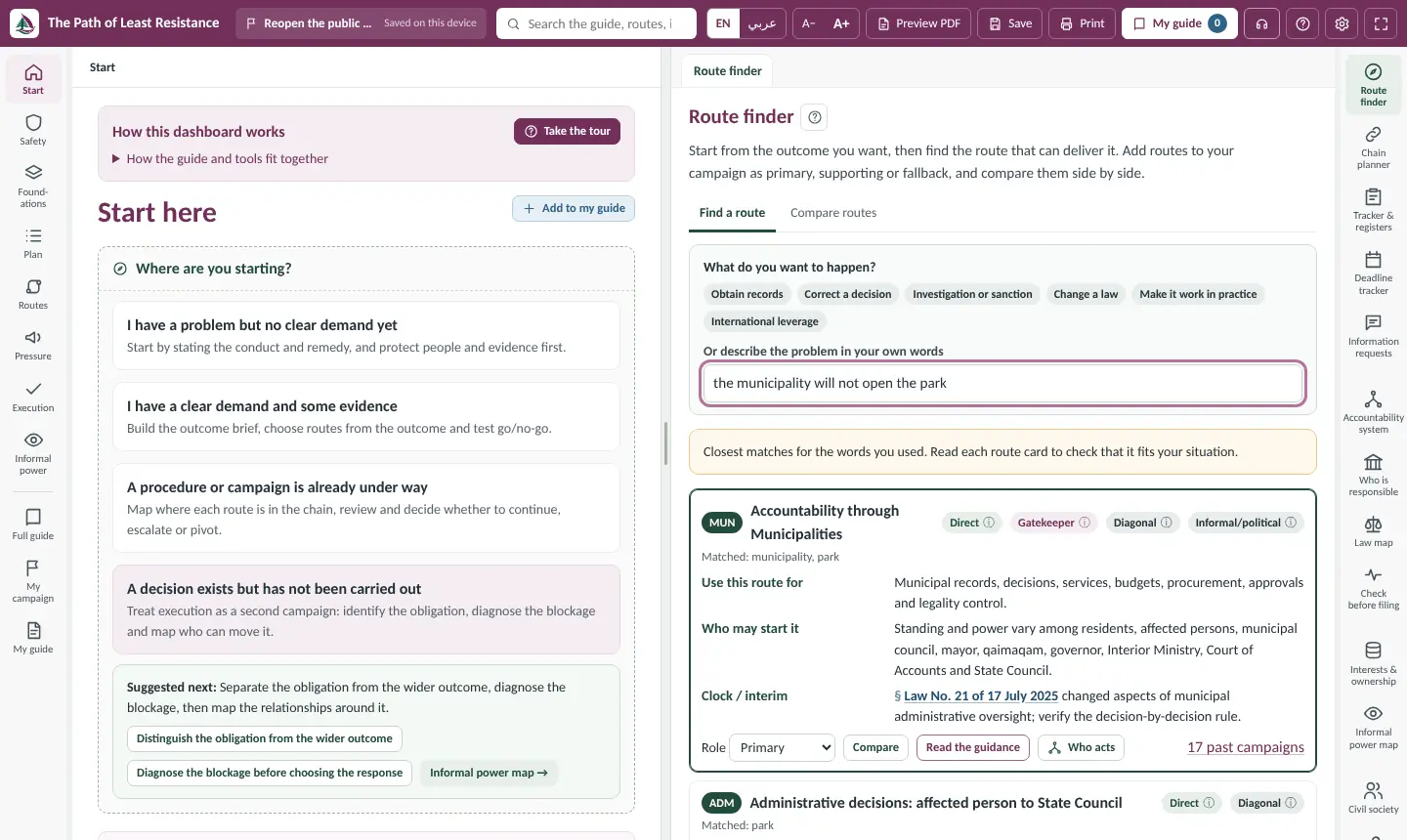
- What could deliver the change we want?Compare 25 formal routes by the outcome you need, in English or Arabic, starting with those you can initiate yourself.Route finder
- When do we need to act?Calculate legal deadlines using Lebanese working days and public holidays, with warnings for strikes and closures and dates you can add to your calendar.Deadline tracker
- How do we get the official records?Choose from 145 record holders, draft an information request in Arabic, track the reply period and prepare a follow-up complaint if needed.Information requests
- Which reforms and promises need following up?Follow 120 reforms and commitments and 78 public pledges by the President and ministers: what must happen, who must act and where delivery stands.Reform tracker
Understand the system
Trace responsibility and authority, then check the conditions for using a route.
- Who represents this place?See who holds office over a municipality or district, from the 2025 council to governors, MPs and ministers, and what each office can do.Representatives and officials
- Who has the power to act on this?Trace who can act on whom, through which mechanism. Follow a route through the institutions involved or explore one body’s connections.Accountability system map
- Which body is responsible?Find the body behind a decision or service, with its duties, leadership, oversight and legal basis.Who is responsible
- Which law applies?Follow a law to the decrees and decisions that amend or implement it, with official Arabic texts and warnings where implementing decrees are missing.Law map
- Can we use this body?Check recorded appointment, quorum and complaint-reception status before committing to a route. Every status shows when it was checked.Check before filing
Map power and interests
Explore documented interests, political ties, foreign involvement and practical influence around a decision. Recorded links are leads to check, not findings of wrongdoing.
- What interests are recorded around this decision?Search documented economic interests of MPs, ministers, party officials and mayors by place, person, party or sector, or see on a map how they connect, with sources and dates.Interests and ownership directory and map
- Who can move or block this in practice?Map duty, practical control, resources, informal influence and collective support around an unmet obligation. Separate what is known, reported and still to investigate.Informal power map
- Who is linked to which party?See the chamber by bloc and its 16 committees, the Cabinet, and 226 dated political relationships, from nominations and confidence votes to alliances and ruptures.Political landscape and relationships
- Which foreign states and international bodies are involved?Explore 322 states, embassies, UN entities, donors and international NGOs: what each is recorded as doing in Lebanon, with its projects, funding and partners.Foreign and international actors
- How is everything connected?See more than 6,800 recorded links across every dataset on one map, with grants, loans, sanctions, mediation, contracts and other instruments of influence marked.Lebanon Network Map
Work with others
Find partners, places to organise and experience your campaign can build on.
- Who already works on this issue?Find relevant work and support among 557 organisations, groups, networks and coalitions, with campaign records, and see their 810 documented relationships on a map.Change directory and map
- Who organises this trade, profession or campus?Find 482 unions, syndicates, professional orders and federations, and 480 universities and institutes, with their legal texts, leaders and recorded political links.Unions and Syndicates · Universities
- Where can we meet or organise?Explore 186 community centres, libraries, cultural spaces, gardens and social enterprises, filtered by the activity you have in mind.Civic spaces
- What have others tried?Learn from 104 Lebanese campaigns: their organising, routes, results and unfinished work. Compare campaigns, or find those that beat a blockage like yours.Campaign library
Explore first, then bring useful findings into a campaign. Tools and maps lets you save maps as images, with sources and credit for reuse.
Browse all tools and mapsCarry a campaign from the first question to implementation.
The Path of Least Resistance connects the guide, forty tools and a campaign file you control. Plan formal action and public pressure together, coordinate partners and keep a record of how institutions respond, from the first request to proof of delivery.
- Define the change you needStart with a problem, a clear demand, a procedure under way or a decision awaiting implementation. Build a brief around the duty, evidence and remedy.
- Test the route before committingCheck who can start it, what the body can deliver, the deadline and its recorded operating status. Choose a primary route and a fallback.
- Coordinate action and pressurePrepare requests, track deadlines and responsibilities, and merge partners’ contributions. Link organising and media work to the formal step each is meant to advance.
- Track delivery and keep the learningFollow implementation with named owners, dates and proof. Share a printable plan and keep the campaign’s evidence, relationships and lessons available for the next effort.
- Free, no account
- Your work stays on your device
- English and Arabic
- Works on phones
- Shareable, printable plans
Have a cause? We help you build the movement around it.
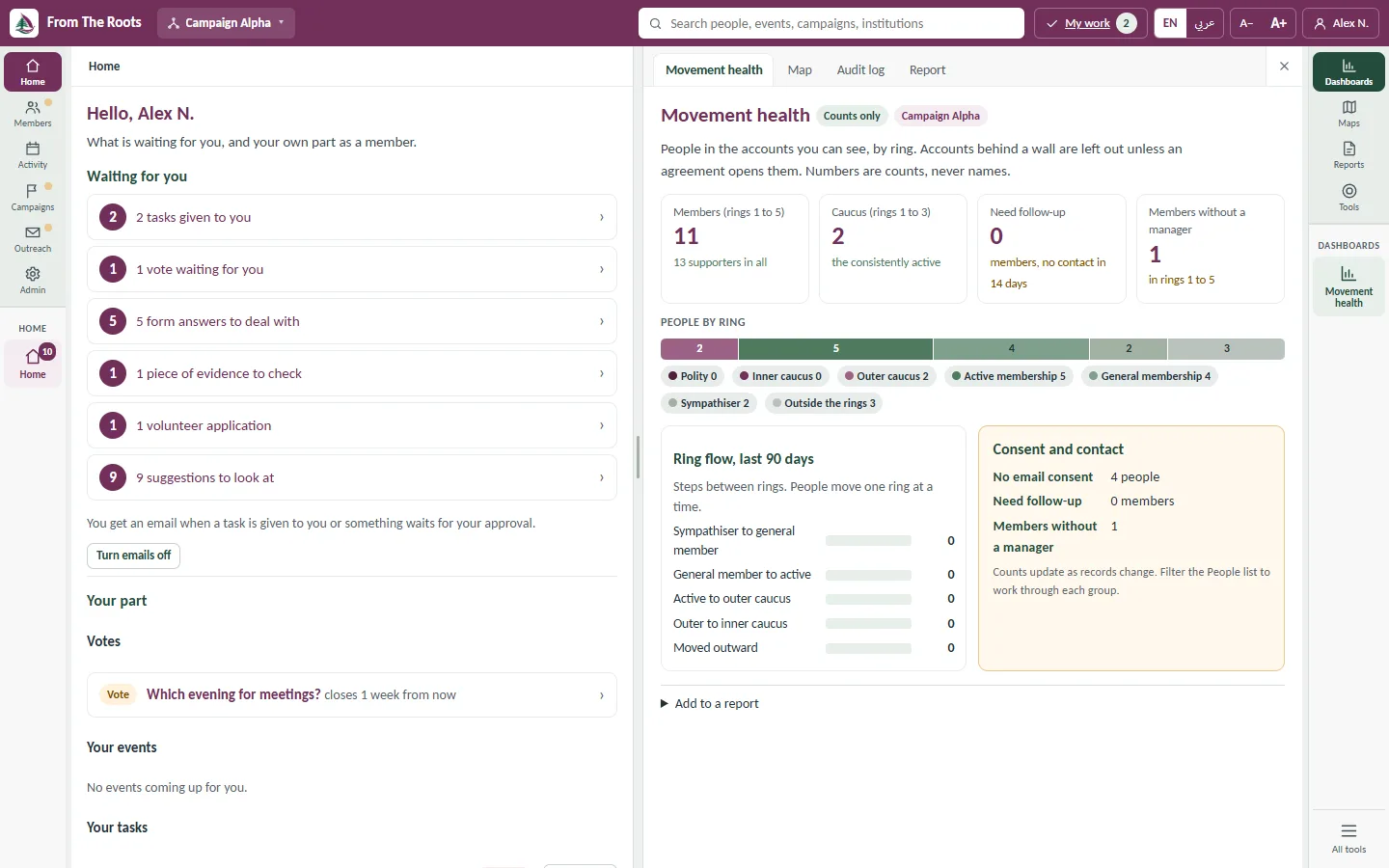
The Cedar Grows works alongside citizens who want to change something specific. Groups we incubate get the tools, the infrastructure and the support to organise people, run campaigns and keep going until the change is made.
- The toolsYour group’s own space in From The Roots, our organising software: people, plans, field work, petitions, decisions and results.
- The infrastructureWe host it, secure it and back it up. No server, developer or software budget needed.
- The knowledgeOur research on who has the power to act on your issue, which formal routes exist and their deadlines.
- The supportHelp to set up, bring in your contacts and shape your first campaign plan.
- Free
- No set end date
- Apply at any time
- No conditions to express interest
Today’s work for change carries a much longer history.
Groups working on different issues across Lebanon can contribute to a shared, unfinished project: a nation able to exercise authority over its own state. Understanding that history helps a campaign see what it inherits and what it can add.
Nābet, our draft history, traces almost two centuries of this struggle through the question of how people reach the state and exercise power over it. It examines the contest between these two ways of organising public life.
Explore the history we inheritPeople exercise rights and seek public action through institutions they can use and hold to account.
People depend on a leader to secure access to the state and obtain what they need.
These are ways of organising power, not labels for people, parties or religious communities.
Practical support for people
working for change.
The Cedar Grows is an independent, non-sectarian initiative based in Matn, Lebanon, with representatives in Melbourne, Sydney and Paris. We help communities and civil society investigate public problems, organise and pursue accountable government.
Campaigns are owned and led by the people running them. We contribute research, practical tools and connections that groups can use for their own demands and build on over time. Our resources are for everyone living in Lebanon, across communities, regions and backgrounds.
Bring your campaign questions and what you have learned.
Tell us what you are working on, or help improve the resources:
- think through a route, evidence, safety or coalition question
- build a movement around your cause with our movement incubator
- correct an entry or suggest an organisation or campaign, with a source where possible
- contribute research or practical experience, or discuss working together